
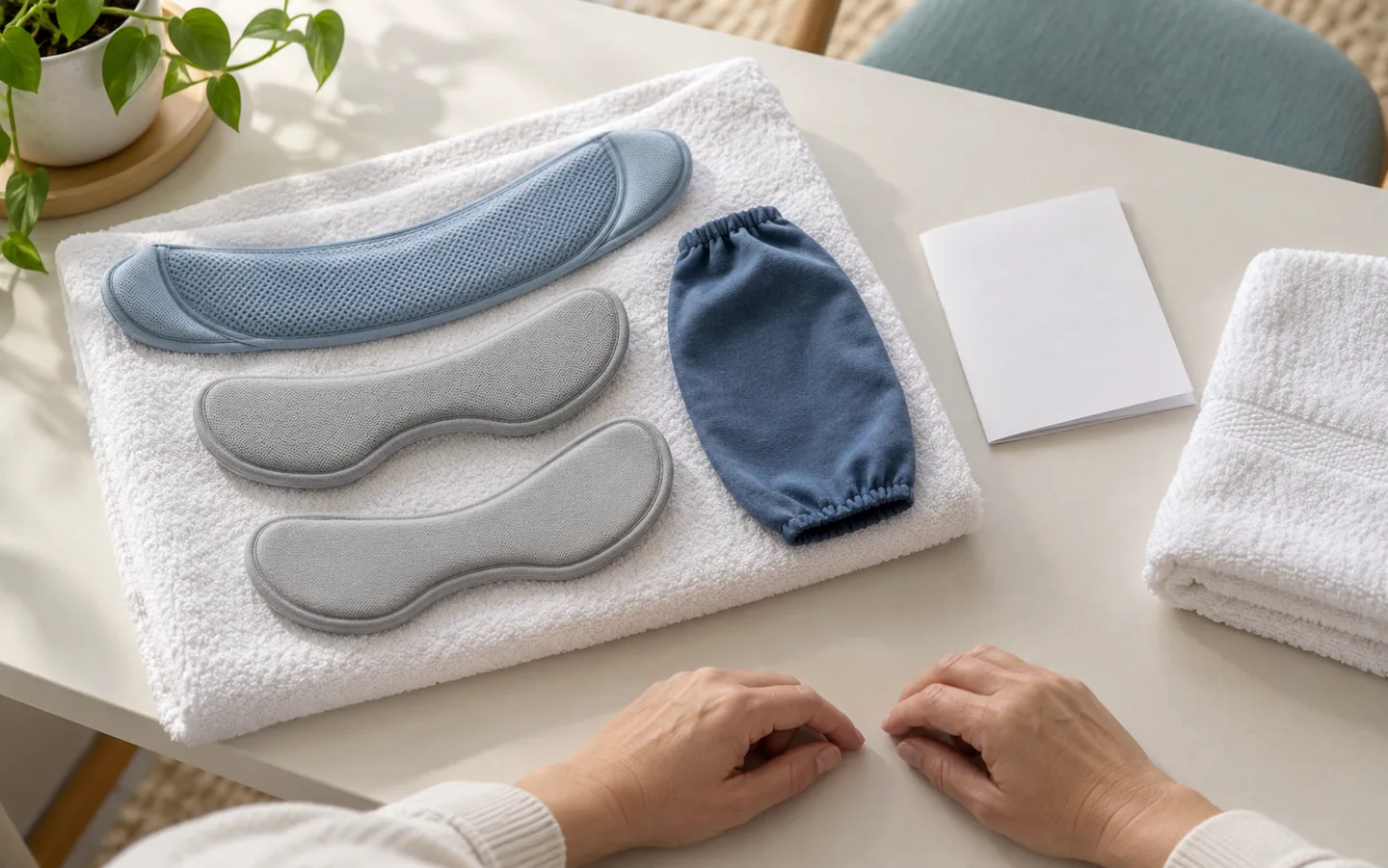
Cervical Collar Replacement Pads: Match Your Model
Cervical collar replacement pads need to match the exact device you already have. Start with the manufacturer, complete model name, and product label, then have the supplier confirm the correct pad set. A similar shape, familiar brand, or matching color is not enough to establish compatibility.
This guide helps you organize a replacement-parts order. It does not tell you to remove a prescribed collar, change its settings, or choose a different device. If you need new pads because the collar is rubbing, damaged, or no longer fitting properly, tell your care team about that problem as well.
Identify the Collar Before Searching for Pads
“Aspen pads” or “Miami collar liner” may seem specific, but those searches can mix different products. Copy the full name from the paperwork or an accessible label. Do not dismantle or take off the collar just to find an identifier; your clinic or original supplier may already have it in your records.
Create a short identification note containing:
- Manufacturer and full model: include words such as Select, MultiPost, or TX.
- Collar product number: distinguish this from the replacement-pad number.
- Size or version: include an adult or pediatric designation when present.
- Back-panel or other accessory details: record any separately named component.
- What needs replacing: a complete liner set, one pad, or another component.
- Who supplied it: keep the clinic or equipment supplier’s contact information.
A purchase receipt can help, but check whether its number belongs to the manufacturer or only to the seller’s inventory. If two documents disagree, ask the supplier to reconcile them before ordering.
Examples That Show Why the Full Name Matters
The entries below illustrate differences in official product information checked in October 2026. They are identification examples, not a substitution chart or product ranking. Manufacturers may revise parts and catalogs, so confirm the current item for your own device before purchase.
| Device or product family | Official identification example | What to confirm |
|---|---|---|
| Aspen Vista cervical collar | Aspen lists the collar as 984000 and Vista replacement pads as 984020. | The order is for the existing Vista model, rather than a different Aspen collar. |
| Aspen Vista MultiPost collar | Aspen’s 2026 catalog lists collar 984200 and replacement pads 984220. | MultiPost is included in the product description; the similar Vista name alone is insufficient. |
| Össur Miami J Select | Össur provides a separate patient guide for Select, including its own pad-care and color-orientation information. | The supplier identifies a pad set for Select and confirms its current ordering code. Do not infer compatibility from blue-and-gray padding. |
| Breg Pinnacle CTO and CTO4 | Breg lists CTO pads as SP40205-000 and CTO4 pads as SP40206-000. | These are cervicothoracic braces, not standalone collars. The similar names still have distinct pad entries. |
Check the linked Aspen product listings, Aspen product catalog, and Breg Pinnacle part table against the supplier’s description. A table entry is not confirmation that your particular component configuration matches it.
Check What the Package Actually Contains
A listing may describe pads, a single chin pad, a collar supplied with an extra pad set, or a different accessory. Read the package contents as closely as the title. Do not assume that a product photo shows everything included in the order.
Ask whether the purchase contains the complete set you need or only a named component. Confirm the quantity, the current manufacturer part number, and whether any size choice is required. If the seller uses the phrase “replacement liner,” ask exactly which pieces that means.
A fabric cover and a replacement pad set should not be treated as the same purchase without checking the device instructions. Likewise, ordering pads does not replace a damaged shell, strap, or other structural part. Our guide to when a neck brace needs replacement separates maintenance questions from problems that need a device assessment.
Get Compatibility Confirmed Before Opening the Package
Send the supplier the identification note and ask for a clear response: “Does this exact item match this exact collar and its current back panel?” Include a photo of an accessible product label if requested through the supplier’s appropriate contact channel. There is no need to include unrelated medical records.

Before ordering, also ask about delivery time and the return policy, particularly whether opening the packaging changes your options. Those are seller-specific terms; a policy on another website may not apply.
When the package arrives, compare its label with the confirmed order while it is still unopened. A different number, missing model word, or unexpected size is a reason to ask for clarification. Do not trim, combine, or add materials to make an uncertain item resemble the old pads.
Plan for a Spare Set Within Your Existing Care Instructions
A spare set may be part of the pad-care arrangement your team has taught you. Cambridge University Hospitals advises its Vista-collar patients to ask if spare pads were not supplied and to contact the clinical team if replacement pads run out. That is a useful question to resolve before supplies become urgent.
Ask who will show you or your caregiver how the correct pads are changed, what assistance is required, and which written instructions apply. Do not use having a spare set as permission to remove the collar or alter a prescribed wearing schedule.
For example, the Miami J Select patient guide specifies its own washing, drying, and pad-orientation details. Those instructions identify that particular product; they should not be copied onto another brand or model. For the broader distinction between cleaning the shell and caring for removable pads, read our cervical collar cleaning guide.
Do Not Treat New Pads as a Fix for Every Problem
Tell your care team if the reason for the order is new rubbing, skin damage, increasing discomfort, or a collar that no longer sits as expected. Cambridge University Hospitals identifies damaged skin, device damage, and poor fit as reasons to seek advice. Buying fresh padding does not assess those concerns.
Keep the description practical: which area is uncomfortable, when it started, whether the device appears damaged, and which supplies you have. Do not tighten the collar or change its height to compensate while waiting for a delivery. Our article on common cervical collar mistakes explains why unapproved adjustments can complicate care.
Questions About Ordering Replacement Pads
Does “universal” mean a pad fits any collar?
Do not read it that way. Ask what the term means in that particular listing and which exact models it covers. A size description is not, by itself, evidence of compatibility with another product.
Can I use the collar’s product number to order pads?
Use it to identify the device, then request the corresponding pad number. As the examples above show, the collar, a collar-and-spares package, and the replacement pads may have separate entries.
Should I order a new collar instead?
Ask the original supplier or treating team which component needs attention. A parts-shopping decision should not become an unsupervised change of device. Have damage, poor fit, or skin problems assessed rather than deciding between products from photos.
Sources
Related posts




NEW POSTS

November 1, 2026
CTO Brace: How It Differs From a Cervical Collar
October 31, 2026
Medicare Neck Brace Coverage: What to Check

October 31, 2026
Can You Work With a Cervical Collar?

October 30, 2026